Image Slider

Showing posts with label The Afternoon Blouse. Show all posts

Afternoon Blouse Pattern Hack - Adding Waist Ties

Wednesday, June 4, 2014
So, you want to make an Afternoon Blouse, but you have one problem - you're never going to wear it tucked in so you'd like it to be a little more fitted.

While you could easily grade it in a size (or two) at the waist, have you ever thought about adding in waist ties?


Adding waist ties to your Afternoon Blouse (or any top for that matter!) is easy, cute, and has the added bonus of you being able to let them out a little after lunch time, while still looking chic!

Supplies:

Steps:
1. First up you'll need to decide how long and how wide you want your waist ties to be. Once sewn up, mine are 70cm (27.5") long and 4cm (1.5") wide. Once you've decided on these measurements, you'll need to add on your seam allowance (I used 1cm (3/8")). So my rectangle pattern measures 71cm long and 10cm wide total (the width is doubled since it's folded over).

2. Draft up your rectangle pattern onto paper, then using that pattern, cut out 2 waist ties from your chosen fabric.

Optional Step - if you want your waist ties to have some extra body, add interfacing to the wrong side of each one before continuing.

3. Fold in half length-wise, right-sides together and press.

4. Feel free to leave the ends of your waist ties square, but I decided to make my waist ties with an angled tip. To do this, cut off a triangle at the end, angling out from the raw edge of your waist tie towards the tip. How sharp you want your tip is entirely up to you!


5. Starting at one end, leaving the shorter edge open, stitch raw edges together.


6. Trim seam allowance and corners


7. Turn waist tie right-side out and press.


8. Repeat with other waist tie.

9. Sew up your Afternoon Blouse as per the instructions until you get to the step where you sew up the sides. Locate where your waist sits on the side of the blouse and pin waist tie to the right-side of the front bodice, matching up raw edges.

Note - if you've angled your tips, make sure the longer end is on top, as per the photo below.


10. Baste in place into the seam allowance. Repeat for other side making sure waist ties are matching up.

11. Sandwich your waist ties in between your front and back bodice, being careful not to catch the loose ends of your waist ties in your side seam, sew up your side seams and finish the blouse as per the instructions.


Ta da! One cute Afternoon Blouse with waist ties coming up!

xx
J

Quick Tips for Sewing with Silk

Sunday, April 27, 2014

Silk is such a luxurious fabric to wear, unfortunately, sewing with it is not so luxurious. In fact, it's a real pain in the butt if I'm being honest. So today, I wanted to share a few tips about sewing with silk (and other fine/slippery fabrics) that I've picked up in my time sewing with it, just in case you fancy making your Afternoon Blouse from it.

The major issue I've always encountered with silk is that because it's so slippery, it tends to move off grain during cutting. Unfortunately, you can muslin a garment as many times as you like to get the fit right, but if the pattern pieces slip off grain when it comes time to making it with your fashion fabric, chances are the final garment won't fit right. So...

1) Think about cutting one pattern piece at a time instead of folding your fabric to cut out 2 pieces. It might take longer, but generally, the pattern piece that is going to slip and go off grain is going to be the bottom piece. For pattern pieces that are placed on the fold, I would recommend re-tracing the pattern piece into one whole piece, and cutting in a single layer from that.

2) If you prefer to cut your fabric on the fold, try putting it between 2 pieces of tracing paper. Sounds weird I know, but the tracing paper has more grip than silk, which means it will hold those slippery pieces together. To do this, fold your fabric along the grain and pin your selvedges together. Place your folded fabric on top of a piece of tracing paper, and then put another piece of tracing paper on top of that. Pin your pattern pieces on top of the tracing paper, making sure to get all four layers secured, and cut your pattern pieces out.

3) Use silk pins AND pattern weights. For some reason, there is a mindset that you either need to be in one camp or the other when it comes to securing pattern pieces to your fabric, but this really is not the case, especially when it comes to cutting silk and other difficult fabrics.

Most people have their favourite way to secure patterns (mine is with pins) but use both if you have to. I use cans from the cupboard and weigh my pattern piece down in the centre (use as many as you like!), then pin the outsides of the pattern with pins (again, use as many as you like). It might sound a bit overkill, but if you've ever experienced the dread of ruining a lovely bit of fabric, you'll do anything to stop this happening in the future.

4) Which brings me to pins. If you don't have silk pins, and have no plans to buy any, ONLY PIN INTO THE SEAM ALLOWANCE! Pins will leave little holes all throughout your silk that are nearly impossible to make go away, no matter how hard you try to push them closed. And actually, even if you do have silk pins, I would still try to keep them within the seam allowance, just in case!

5) When it comes to silky necklines, you should think about stabilising the seam to give it a bit more structure. Silk is designed to flow, so if you have a neckline that needs to hold it's shape like the Afternoon Blouse, giving it a little extra love will help it to retain the original design lines.

Not sure how to stabilise seams? Check out my post here.

6) Take your time! You just can't rush sewing with silk - if you do, it will come back to bite you in the bum. Enjoy the process, listen to the fabric (fabric whisperer?) and you should end up with a lovely garment at the end.

If you have any more tips for sewing with silk, I'd love to hear them! I'm always on the lookout for ways to make it easier (and hopefully not ruin any more beautiful fabric!).

xx
J

Stabilising Seams - Tips & Tricks

Thursday, April 17, 2014
 photo Stabilising-Seams-Banner_zps87eaa748.jpg

If you're planning on making an Afternoon Blouse from a lightweight or slippery fabric like silk or rayon, you're probably going to want to stabilise your neckline seams to stop them from drooping out of shape.

Stabilising seams is a simple technique used to give a bit of extra oomph to a seam, whether it's to the shoulders on knit tops to stop them stretching out, or the neckline on your Afternoon Blouse to help it keep it's shape. It only takes a few extra steps and is totally worth the effort.

You can use almost anything with a bit of strength to stabilise your seams. Twill tape or ribbon work just fine, but if you're using a really light weight fabric you'll want to minimise seam bulk, so try using an interfaced bias strip of the same fabric or if you're feeling fancy, a bias strip of silk organza.

Note - Using a bias strip is best if you are trying to stabilise a curved seam as it will bend and curve with your seam.

There are two ways you can sew your stabilising strip onto your garment. You can either sew it directly onto the seam line (Picture 1 & 2) or you can sew it as close as you can get it to the seam line but within the seam allowance (Picture 3 & 4). They both have their place, but for the Afternoon Blouse, you'll want to sew it onto your seam allowance and not into your seam. This will ensure you have a lovely delicate but stabilised neckline, without the bulk.


Picture 1 & 2 - Place your stabilising strip right on top of your seam line, and sew in place.


Picture 3 & 4 - Place your stabilising strip as close to the seam line as you can get, within the seam allowance, and sew in place.

Note - I've used a small width twill tape in the pictures above to illustrate where you should place your stabilising strip but it's totally up to you how wide your strip is. For the Afternoon Blouse, since you'll be sewing it into your seam allowance, I would go with a strip that is just under the seam allowance width or smaller.

Another way you could think about stabilising your neckline is to add piping to it as Melissa did - the piping essentially works as a decorative form of seam stabilisation. However, do be careful with the type of piping fabric you use here, as it can add a lot of extra bulk. If you think you might want to give piping a go, I have a tutorial on making and inserting inseam piping here.

I personally don't think there is any need to stabilise the neckline on your Afternoon Blouse if you're using a sturdier fabric like cotton voile or lawn as they should hold their shape just fine, but feel free to do this if you feel your fabric is especially lightweight, or if you just want to see what all the fuss is about.

xx
J

Printing & Assembling PDF Patterns...The Afternoon Blouse

Friday, April 11, 2014

If you're new to sewing or dress-making, seeing a PDF pattern can either be the boost you need to get going because it's so instant, or it can be intimidating, because, how the heck does that all work anyway?

As I've just released my first pattern, The Afternoon Blouse, which is currently only available as a PDF pattern, I've written a quick tutorial on putting it together, so you can see just how easy it can be.

Now, the way I've laid out my pattern is a little different to your conventional PDF pattern. Why? Well, I've made it easier!

Instead of having to print out every-single-piece and join them all together in one big lump, I've broken them up for you. You can choose to print out each pattern piece individually, which means if you are only wanting to make one version, you can select the page numbers of the pieces you need, and print out those pieces only. This makes putting your pattern together faster (because you aren't taping a huge sheet together and therefore don't need to rearrange your entire living room to make enough floor space) and it also minimises paper wastage, because you aren't printing out unnecessary pattern pieces. So really, it's a win-win in my book.

Before we get to the printing and assembling bit of The Afternoon Blouse pattern, first you should decide what option you are wanting to make (and you're totally allowed to make both. In fact, it's encouraged!). You'll need to choose the following page ranges depending on the version you are making -

Version 1
Pages 3-5 (Facing Pieces) & 6-23 (Front and Back pieces)

Version 2
Pages 1-3 (Facing Pieces) & 6-14 (Back piece) & 24-31 (Front piece)

Supplies:
Afternoon Blouse PDF Pattern
A4 or Letter printer paper
Adobe PDF Reader Software (free to download here) or other PDF Reader
Tape or Glue
Ruler
Scissors (optional!!)

Steps:

1. Once you've downloaded and saved your Afternoon Blouse pattern and instruction sheet to your computer, open your PDF Pattern and select 'Print'

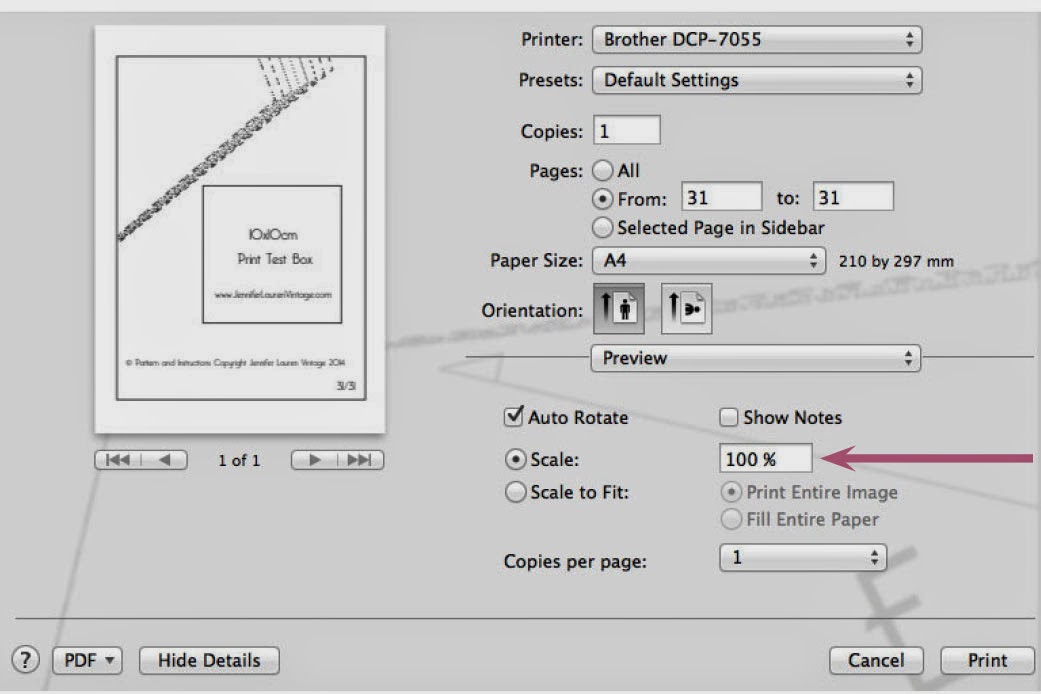
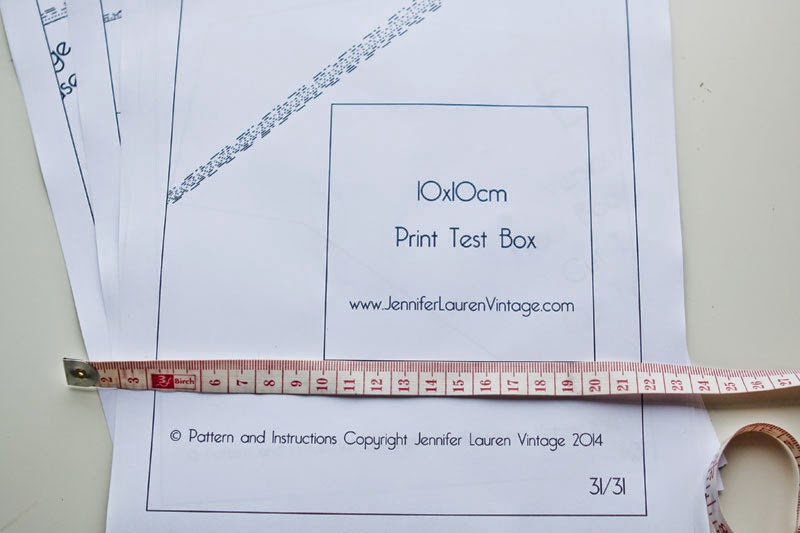
2. In your print options, select 'Actual Size' or 'Scale 100%' depending on which setting you have (I have the Scale 100% setting in my print options) and print page 31. This page has a handy Print Test Box that you can use to ensure you are printing to the right scale. Take your ruler and measure the sides of the box, they should measure 10cm x 10cm.


3. Once your print test box is measuring the correct size, you can go ahead and print out your pattern. You can choose to print just one version by selecting the page ranges you require (listed above).

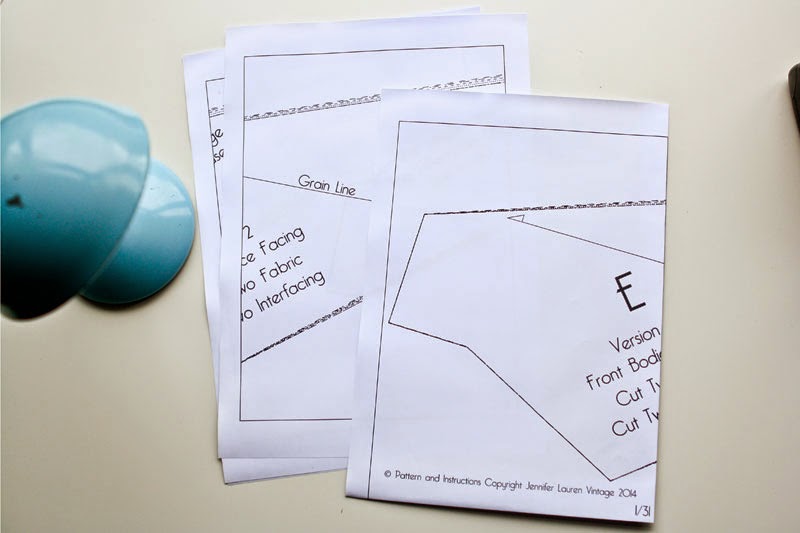
4. Once your pattern is printed, you'll notice that there are page numbers at the bottom of each printed page. To ensure your pattern piece is up the right way, these need to be in the bottom right hand corner.

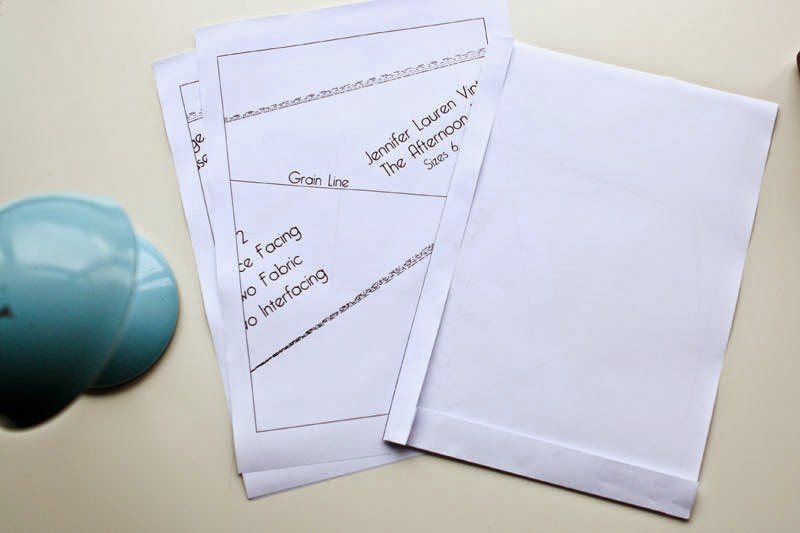
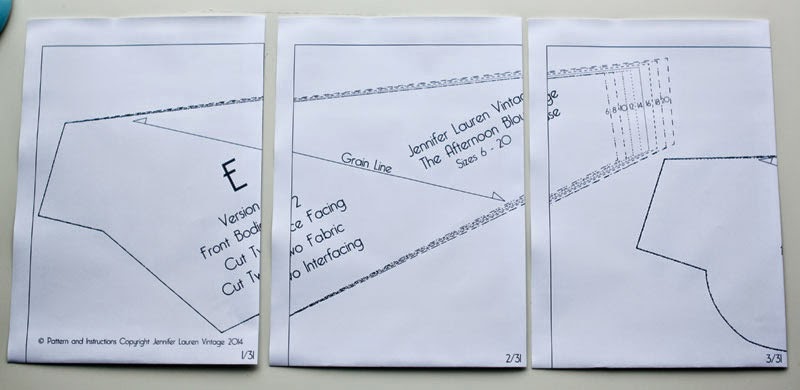
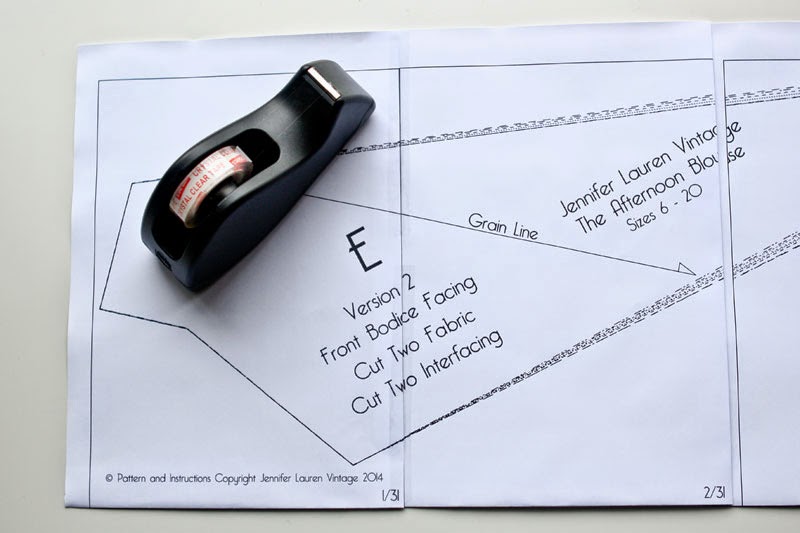
5. At this stage, you can either choose to fold your borders back, or cut them. Fold or cut the bottom side and the right side of each pattern piece in order to make it easy to lay them on top of each other to join them together.


6. On page 3 of your instructions, you'll find a Lay Plan of how you should lay each piece of paper together. Follow this guide and lay out your pieces of printed pattern.

7. Join each pattern piece together, making sure to line up borders and pattern lines from each piece to the next and tape or glue in place.


8. And, erm, that's it! Now you're ready to trace your pattern and spend the afternoon sewing.

xx
J

The Afternoon Blouse is Here...

Friday, April 4, 2014
Well folks, you can now buy your very own Afternoon Blouse pattern right here. Just in time for some Easter Weekend sewing!


Thank you so much for all of your sweet comments last week when I announced that I had been working on my first pattern. It's really rather a nerve racking thing to have worked to hard and spent so much time on something and not know how people are going to react. I said it in my last post and I'll say it again - your comments have been so supportive and really very humbling. THANK YOU!

I've decided that I'm not going to be running a sew-a-long per say, mostly because it's such an easy pattern, but I will be writing a number of posts about the blouse on things like stabilising seams (especially useful if you plan to make the blouse using silks, rayons or other 'slinky' fabrics), pattern hacks (a sleeveless version anyone? Or how about adding waist-ties for a bit more definition if you want to wear it untucked?) as well as a tutorial on printing and assembling your Afternoon Blouse Pattern as I've chosen to lay my pattern out a bit differently to other PDF patterns, which hopefully means it's easier to put together and you'll have less paper wastage!


So, ummmm, I guess all there is to do now is go get your own copy of the blouse, find that amazing vintage button that for some reason you only have one of, set aside an afternoon and get sewing, huh?

If you make an Afternoon Blouse, well, I'd REALLY like to see them, so please let me know if you've blogged about one, or feel free to email me a picture :)

Yay!

xx
J

The Afternoon Blouse - Pattern Release Sneak Peek...

Friday, March 28, 2014
So, I've been keeping secrets. I've been busily working away on my first pattern for release, The Afternoon Blouse!


WHAAAA! {insert excited, nervous, happy dance here}

Yes, I know - everyone and their cat (and/or dog, fish, rabbit, guinea pig, chickens...etc) have been releasing patterns lately, but after a few doubts and some sage advice, I thought 'Why not?!' and bit the bullet. You see, sewing is my passion and I want to share it with everyone I possibly can. The worst that can happen is everyone hates my patterns and doesn't buy them, but at least I've had fun making them right?

So, how did this all come to be? Well, it sort of started when I approached our local Recreation Centre about the possibility of teaching sewing classes there (oh yeah, did I mention I'm going to be teaching sewing classes starting on Monday? YAY!! Except, more nervous dancing - what if I forget how to sew?). I wanted to teach two classes initially to gage reaction to them, one a Learn to Sew class and the other an Introduction to Dressmaking class. For the latter, I decided that I kind of wanted to teach my own patterns and so away I delved, into the relatively unknown. Cue: huge learning process here.

These patterns were originally going to just be for my classes, but then I realised what a whole buttload of work was going into one little pattern, that I wondered if I should sell them too. Just in case, you know, any of you wanted to make one!

So, my first pattern, The Afternoon Blouse.  I guess you could sort of call it a retro-vival pattern, as it is based off an original 50s pattern. However, I had made a number of significant fit changes to my original Afternoon Blouses and I've made even more changes to the pattern that I'm going to be releasing. I've made it easier to construct, have drafted a second neckline option and have made the overall shape and design of the blouse more modern so it should blend in well with a vintage and modern wardrobe.

It is a beginners pattern but for the advanced sewer, you should be able to make the blouse in an afternoon - hence the name, but it's also kind of perfect for receiving afternoon guests and for just kicking around in on a lazy Sunday afternoon - making for a quick and satisfying make.

As I said above, the blouse has two necklines to choose from, a round version and a square version. The Button detail on both versions is decorative (aka non-functioning) and it also has my very favourite, soft 1940s style kimono sleeves.  While the blouse is designed to be tucked into high waisted skirts and pants, it looks equally cool worn with jeans and sandals for the modern gal. Really, it's the perfect flowy blouse for those of you heading into summer, and you can make it up in luxurious silk or a practical cotton. Both work perfectly!

The pattern is currently with my lovely testers at the moment and it will be available in the next week or two. At this stage, I'm only going to be releasing it in PDF format, however, if there is enough of a demand for paper patterns, then I'll certainly look into getting them done as well.

AND if you don't sew, but want one, I'm going to be taking orders to make custom Afternoon Blouses for all! Ain't no reason why you non-sewers should miss out, right?! The Afternoon Blouse ranges in size from an NZ6 right through to an NZ20.

So, keep an eye out for when the pattern is officially released for download straight to your computer - I'll be announcing it right here! I'm also pretty sure there'll be a giveaway somewhere in there as well.

Can't wait to hear what you think!!

xx
Jen

Auto Post Signature

Auto Post  Signature